

The Singapore Sling: History, Composition, and Cultural Legacy of an Iconic Cocktail
Few beverages in the annals of mixology carry the historical romance, colonial intrigue, and global recognition of the Singapore Sling. Created in the early twentieth century at the famed Raffles Hotel, this vibrant, ruby-hued cocktail has evolved from a discreet social refreshment into an enduring emblem of Singaporean hospitality and heritage. Over more than a century, the Singapore Sling has survived shifting cocktail trends, lost and rediscovered recipes, and global reinterpretation, retaining its status as one of the world’s most celebrated tropical libations. Understanding its origins, intricate flavor profile, historical evolution, and cultural significance offers a fascinating glimpse into the social history of colonial and modern Singapore.
Origins at the Raffles Hotel
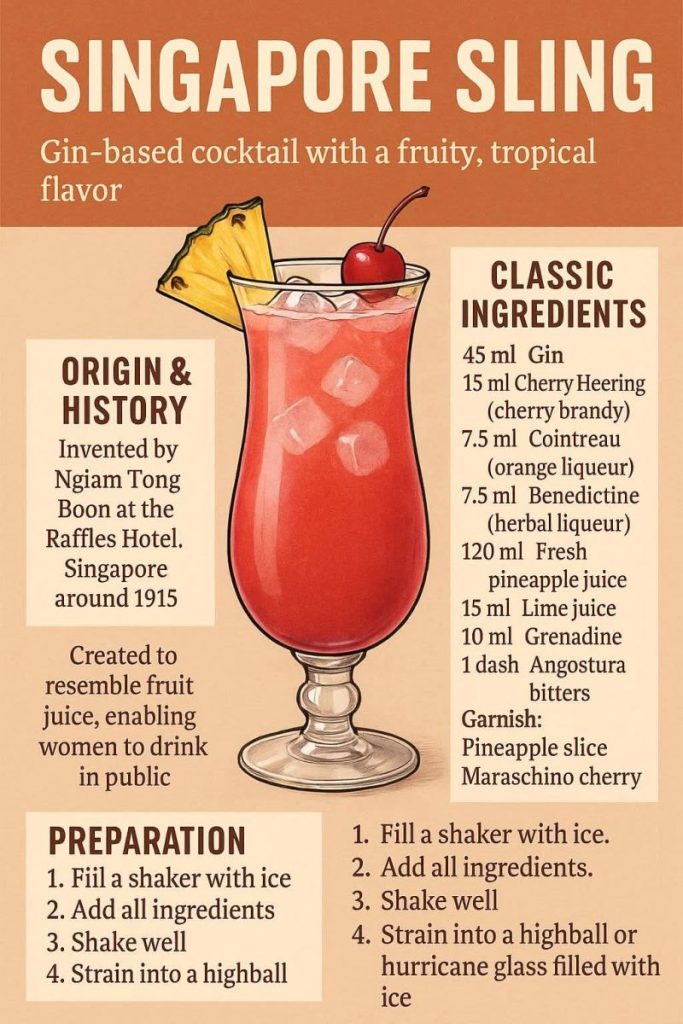
The birth of the Singapore Sling is inextricably linked to the Raffles Hotel, a grand colonial establishment founded in 1887 that quickly became a premier gathering place for expatriates, plantation owners, travelers, and high society in British Malaya. Around 1915, a Hainanese bartender named Ngiam Tong Boon was working at the hotel’s Long Bar when he conceived the drink that would secure his place in culinary history.
During the Victorian and Edwardian eras, strict social etiquette governed public behavior in colonial Singapore. While men freely indulged in gin, whisky, and brandy in public lounges, social norms frowned upon women consuming alcohol openly in public venues. Recognizing an opportunity to cater to female patrons while respecting prevailing conventions, Ngiam Tong Boon set out to craft a cocktail that looked remarkably like an innocent glass of fruit juice. By blending gin with cherry brandy, herbal liqueurs, and tropical fruit juices, he achieved a striking crimson hue topped with a frothy foam. The beverage was refreshing, complex, and visually indistinguishable from a non-alcoholic punch, allowing women to enjoy a spirited drink discreetly in the bustling atmosphere of the Long Bar.
The Anatomy of the Cocktail
The classic Singapore Sling is celebrated for its intricate balance of sweet, sour, herbal, and botanical notes. Unlike simple two- or three-ingredient cocktails, the traditional Raffles Hotel recipe relies on a sophisticated harmony of eight distinct components:
- Gin: Serves as the crisp, botanical backbone of the drink.
- Cherry Brandy (Cherry Heering): Provides deep stone-fruit sweetness and the signature reddish-pink color.
- Cointreau: Adds bright, aromatic orange citrus notes.
- DOM Bénédictine: A complex French herbal liqueur infused with twenty-seven botanicals and spices, lending depth and warmth.
- Pineapple Juice: Introduces tropical sweetness and creates the drink’s characteristic foamy crown when shaken vigorously.
- Fresh Lime Juice: Delivers essential acidity to cut through the richness of the liqueurs and fruit juices.
- Grenadine: Enhances the vibrant crimson color and adds a touch of pomegranate sweetness.
- Angostura Bitters: A single dash binds the diverse flavors together with subtle spice and bitterness.
Traditionally served in a tall Collins or hurricane glass over ice, the cocktail is garnished with a wedge of fresh pineapple and a maraschino cherry. When properly executed, the Singapore Sling avoids being overly sugary; instead, the tartness of the lime, the bitterness of the Angostura, and the dry juniper notes of the gin counterbalance the lush fruit and herbal liqueurs.
Evolution and the Quest for the Original Recipe
As the popularity of the Singapore Sling spread across the globe via international travelers and literary figures—including frequent Raffles patrons such as W. Somerset Maugham and Rudyard Kipling—the recipe inevitably underwent variations. For decades, bartenders worldwide improvised versions using sweet-and-sour mixes, soda water, or inferior syrups, often reducing a nuanced classic into an overly sweet tropical punch.
Even at the Raffles Hotel, the exact proportions used by Ngiam Tong Boon were not formally standardized in writing during his lifetime. Following Ngiam’s passing, bartenders relied on institutional memory, leading to minor variations over the years. In the 1970s, Ngiam’s nephew, who had also worked at the hotel, helped reconstruct the authentic formula based on family recollections and surviving bar notes preserved in the hotel’s museum. This effort restored the prominence of Bénédictine, Cointreau, and Cherry Heering, rescuing the drink from mid-century shortcuts and establishing the standardized recipe served at the Long Bar today.
Cultural Significance and Tourism Icon
In contemporary Singapore, the Singapore Sling occupies a unique cultural space. While it originated during the British colonial era, it has been embraced as a quintessential symbol of Singapore’s storied past and its modern reputation as a global crossroads. For millions of international visitors, making a pilgrimage to the restored Long Bar at the Raffles Hotel—complete with its tropical plantation shutters, punkah fans, and the quirky tradition of tossing peanut shells onto the wooden floor—is a rite of passage.
Beyond the hotel’s walls, the cocktail has inspired a wide array of local culinary adaptations, appearing in desserts, chocolates, jams, and contemporary craft cocktail reinterpretations created by Singapore’s thriving modern bar scene. Even Singapore Airlines serves the Singapore Sling as a signature beverage on its international flights, introducing travelers to the flavors of the island before they even land at Changi Airport.
Leave a Reply