
The World’s Strongest Passport: Power, Diplomacy, and Global Mobility
In an era defined by unprecedented global interconnectedness, the humble passport has evolved from a simple identity document into a potent symbol of geopolitical influence, economic stability, and personal freedom. While all passports serve the fundamental purpose of verifying a holder’s nationality and identity across international borders, the privileges they confer vary dramatically. The concept of the “world’s strongest passport” has become a focal point of international attention, measured annually by prestigious indices that track global mobility. Far more than a mere convenience for vacationers, passport strength reflects a nation’s diplomatic standing, bilateral trust, and integration into the global economy.
Defining Passport Power
Passport power is primarily quantified by the degree of travel freedom a document affords its bearer. Specifically, it is measured by the number of countries and territories a citizen can enter without obtaining a traditional visa prior to departure. This includes strictly visa-free entry, visa-on-arrival arrangements, and streamlined Electronic Travel Authorizations (ETAs).
Two primary benchmarks dominate the assessment of global mobility. The most widely cited is the Henley Passport Index, compiled by the London-based global citizenship and residence advisory firm Henley & Partners, which relies on exclusive data from the International Air Transport Association (IATA). The second is the Passport Index, developed by Arton Capital, which updates in real time based on government policy changes. Although their methodologies differ slightly—leading to minor variations in their top rankings—both indices underscore a profound reality: a small group of nations enjoys near-universal access to the globe, while others face severe restrictions.
The Reigning Champions of Global Mobility
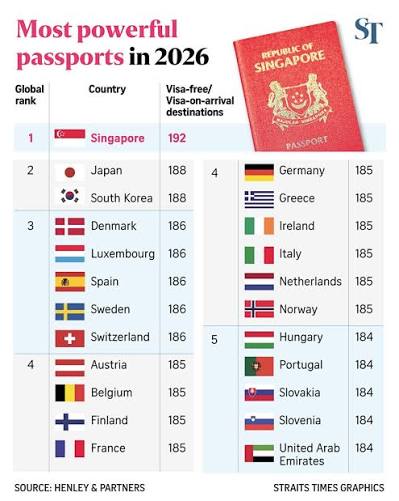
According to the 2026 Henley Passport Index, Singapore holds the coveted title of the world’s strongest passport. Citizens of this Southeast Asian city-state enjoy visa-free or visa-on-arrival access to an astonishing 192 to 193 destinations out of 227 worldwide. Singapore’s ascendancy is no accident; it is the culmination of decades of strategic, non-aligned foreign policy, robust economic governance, and proactive diplomatic engagement with both Western powers and emerging markets.
Close behind Singapore are fellow Asian powerhouses Japan and South Korea, alongside the United Arab Emirates (UAE). Japan and South Korea have long been mainstays at the zenith of passport rankings, bolstered by their status as technological and economic leaders with low rates of illegal immigration and high levels of international trust.
However, the rise of the United Arab Emirates represents the most remarkable trajectory in modern diplomatic history. Over the past decade, the UAE has executed an aggressive and calculated campaign of bilateral visa-waiver agreements. By leveraging its strategic economic partnerships, sovereign wealth, and role as a premier global aviation hub, the UAE climbed dozens of spots to secure the top position on Arton Capital’s Passport Index and tie for second place on the Henley Index.
European nations, particularly those within the Schengen Area such as Sweden, Spain, France, and Germany, also consistently occupy the upper echelons of global rankings. Meanwhile, traditional Western superpowers like the United States and the United Kingdom, while still possessing formidable travel documents granting access to around 180 to 184 destinations, have experienced gradual relative declines from their former peak rankings due to shifting reciprocal visa policies.
The Pillars Behind a Powerful Passport
A nation does not acquire a strong passport by chance. Several interconnected geopolitical and socioeconomic factors determine how widely a country’s citizens are welcomed abroad:
- Diplomatic Reciprocity: Visa policy is inherently reciprocal. Countries that maintain open borders and actively negotiate bilateral visa-waiver treaties naturally secure similar privileges for their own citizens.
- Economic Stability and Wealth: Immigration authorities in host nations assess the likelihood that a visitor will overstay their visa or seek unauthorized employment. Citizens of affluent nations with high standards of living are statistically viewed as low-risk tourists and business travelers, encouraging foreign governments to waive visa requirements.
- Security and Document Integrity: Strong passports are backed by rigorous border controls, stringent vetting processes for citizenship, and advanced biometric security features embedded within the physical passport booklets. When a receiving state trusts the issuing authority’s security apparatus, it is far more willing to grant frictionless entry.
- Geopolitical Neutrality and Soft Power: Nations that avoid protracted international conflicts and maintain stable, predictable foreign relations—such as Singapore and Switzerland—often find it easier to cultivate broad international goodwill.
The Growing Mobility Divide
While the conversation surrounding the world’s strongest passports celebrates unprecedented freedom of movement, it simultaneously highlights a stark and widening global inequality. Over the past twenty years, the gap between the top-ranked and bottom-ranked passports has expanded significantly.
At the opposite end of the spectrum sit nations plagued by chronic political instability, armed conflict, and economic collapse. Passports from countries such as Afghanistan, Syria, and Iraq routinely occupy the lowest rungs of global indices. Citizens holding an Afghan passport, for instance, can access fewer than 25 destinations without securing a complex, costly, and often unattainable visa in advance. For individuals from these nations, international borders represent formidable barriers rather than gateways to opportunity, education, or safety.
Furthermore, online discussions regarding passport strength reveal a deeper nuance beyond raw destination counts. On Reddit, users hold mixed opinions on whether numerical visa-free access tells the whole story. Some argue that European Union passports—such as the Irish passport, which grants the legal right to live, work, and study across both the EU and the United Kingdom—offer superior practical utility compared to passports that merely permit short-term tourism in a slightly higher number of countries. Additionally, emerging frameworks like the Happy Passports Index argue that true passport value should also factor in domestic wellbeing, personal freedom, and quality of life.
Economic and Strategic Implications
The tangible benefits of holding a top-tier passport extend far beyond the avoidance of embassy queues and consular fees. In a globalized economy, frictionless mobility is a vital catalyst for commerce, innovation, and human capital development. Entrepreneurs and corporate executives from nations with strong passports can respond instantaneously to international market opportunities, attend global conferences, and negotiate cross-border deals without administrative delays.
For students and researchers, a powerful passport facilitates effortless participation in international academic exchanges, conferences, and collaborative projects. Recognizing the immense value of this mobility, an entire industry centered around “citizenship by investment” has flourished, allowing high-net-worth individuals from countries with restrictive passports to acquire second citizenships in nations offering superior global access.
Leave a Reply