

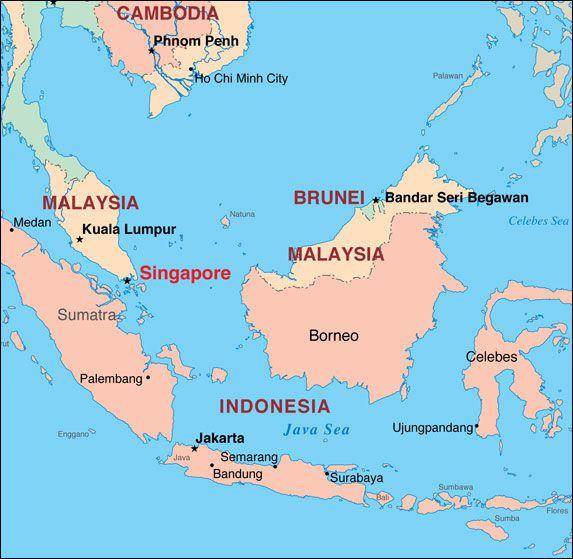
Singapore’s Neighboring Countries: Geography, Diplomacy, and Regional Integration
Situated at the southern tip of the Malay Peninsula in Southeast Asia, the Republic of Singapore occupies one of the most strategically vital locations on the globe. Despite its modest landmass of approximately 735 square kilometers, this island city-state serves as a premier financial, maritime, and aviation hub. Because Singapore has no land borders of its own—being separated from the Asian mainland and surrounding archipelagos by narrow straits—its identity, security, and economic prosperity are inextricably linked to its immediate neighbors. Understanding Singapore’s geopolitical landscape requires a close examination of its two closest maritime neighbors, Malaysia and Indonesia, as well as its broader regional network within the Association of Southeast Asian Nations (ASEAN).
Malaysia: The Closest Northern Neighbor
Separated from Singapore by the narrow Straits of Johor, Malaysia is Singapore’s closest geographic, historical, and cultural neighbor. The two nations share a deeply intertwined past, having both been part of the British Empire and briefly united as a single federation from 1963 until Singapore’s independence in August 1965. Today, their relationship is characterized by intense economic interdependence, shared familial ties, and high-volume daily transit.
Physical Connectivity and Cross-Border Flow
Two major land links span the Straits of Johor, facilitating one of the busiest border crossings in the world:
- The Johor–Singapore Causeway: Opened in 1923, this 1.056-kilometer causeway connects Woodlands in northern Singapore to Johor Bahru in southern Peninsular Malaysia, carrying road traffic, a railway line, and vital water pipelines.
- The Malaysia–Singapore Second Link: Opened in 1998, this 1.92-kilometer bridge connects Tuas in western Singapore to Tanjung Kupang in Johor, alleviating congestion on the original causeway.
To further streamline cross-border mobility, both nations have collaborated on the Johor Bahru–Singapore Rapid Transit System (RTS) Link and the Johor–Singapore Special Economic Zone (JS-SEZ). These initiatives are designed to integrate supply chains, ease daily commuting for hundreds of thousands of workers, and attract global investment to the region.
Economic and Resource Interdependence
Malaysia is consistently one of Singapore’s top trading partners. Thousands of Malaysian professionals and laborers commute daily to Singapore for employment, while Singaporean businesses and consumers rely heavily on Malaysia for agricultural produce, manufacturing, and tourism. Historically, water security has also been a cornerstone of bilateral relations; under longstanding agreements, Singapore imports raw water from Johor and supplies treated water back to the Malaysian state. While diplomatic friction occasionally arises over maritime boundaries, airspace management, and resource pricing, both governments maintain pragmatic, institutional mechanisms to manage differences constructively.
Indonesia: The Vast Southern Archipelago
Directly south of Singapore, across the busy Singapore Strait, lies the Republic of Indonesia—specifically the Riau Islands province, including Batam, Bintan, and Karimun. As the largest economy and most populous nation in Southeast Asia, Indonesia is a pivotal neighbor whose stability and growth directly impact Singapore’s strategic environment.
Maritime Proximity and the Strait of Malacca
Singapore and Indonesia share maritime borders along the Singapore Strait, which forms the southern gateway to the Strait of Malacca. This narrow waterway is one of the world’s most critical maritime chokepoints, carrying a substantial percentage of global seaborne trade and energy supplies between the Indian and Pacific Oceans. Consequently, Singapore and Indonesia—alongside Malaysia—cooperate extensively on maritime security, anti-piracy patrols, environmental protection, and navigational safety.
Economic Synergy: The SIJORI Growth Triangle
Economic cooperation between Singapore and Indonesia is heavily concentrated in the Riau Islands, located just a 45-to-60-minute ferry ride away. Decades ago, Singapore, Johor (Malaysia), and the Riau Islands (Indonesia) formed the SIJORI Growth Triangle, a cross-border economic partnership that combined Singapore’s capital, infrastructure, and global connectivity with the land, labor, and natural resources of its neighbors. Today, Singapore consistently ranks as the largest source of foreign direct investment in Indonesia, with major collaborations spanning industrial parks, renewable energy exports, data centers, and tourism development on Bintan and Batam.
The Broader ASEAN Neighborhood
Beyond its immediate maritime borders with Malaysia and Indonesia, Singapore views the wider Southeast Asian region as its extended neighborhood. Alongside Brunei, Cambodia, Laos, Myanmar, the Philippines, Thailand, and Vietnam (with Timor-Leste in the process of accession), Singapore is a founding member of ASEAN.
- Brunei Darussalam: Located on the northern coast of the island of Borneo, Brunei shares a unique and exceptionally close bond with Singapore. The two nations maintain a Currency Interchangeability Agreement established in 1967, allowing the Singapore dollar and the Brunei dollar to be used interchangeably at par value in both countries. They also conduct extensive joint military training.
- Thailand and Vietnam: Situated slightly further north on mainland Southeast Asia, Thailand and Vietnam are vital economic and diplomatic partners. Both countries serve as key manufacturing hubs, food suppliers, and investment destinations for Singaporean enterprises, connected via dense aviation networks that make Changi Airport a central regional transit point.
- The Philippines, Cambodia, Laos, and Myanmar: Through ASEAN frameworks, Singapore engages with these neighbors on trade liberalization, digital economy agreements, human capital development, and regional disaster relief.
Geopolitical Balance and Regional Diplomacy
As a small state surrounded by much larger neighbors, Singapore’s foreign policy is anchored in the principles of international law, peaceful dispute resolution, and regional multilateralism. Singapore relies on the open sea lanes and airspace controlled by its neighbors for its survival as a trading nation. Therefore, fostering trust, upholding the United Nations Convention on the Law of the Sea (UNCLOS), and maintaining a cohesive, neutral ASEAN are top diplomatic priorities.
By positioning itself as a constructive partner that adds economic value to its neighbors—through infrastructure investment, financial services, and technological transfer—Singapore has successfully transformed potential geographic vulnerabilities into enduring strategic strengths.
Leave a Reply