

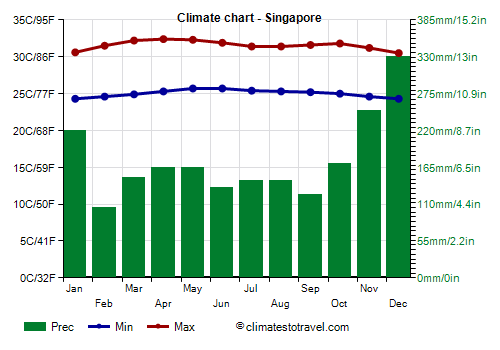
Singapore, an island nation situated just one degree north of the equator, experiences a tropical rainforest climate characterized by uniformly high temperatures, abundant rainfall, and consistently elevated humidity throughout the entire calendar year. Unlike temperate regions that cycle through spring, summer, autumn, and winter, Singapore does not possess distinct thermal seasons. Instead, its annual weather patterns are governed by two primary monsoon systems separated by two brief inter-monsoon periods. Consequently, average daily temperatures typically hover between 25 degrees Celsius and 31 degrees Celsius, while relative humidity frequently exceeds 80 percent, particularly during the early morning hours. Understanding the subtle monthly variations in precipitation, wind direction, and sunshine duration allows residents, travelers, and businesses to plan their activities effectively across all twelve months.
January falls squarely within the wet phase of the Northeast Monsoon, which generally prevails from December through early March. During January, prevailing winds blow steadily from the north or northeast, bringing frequent, widespread, and occasionally prolonged moderate-to-heavy rainfall across the island. Cloud cover tends to be extensive, which slightly moderates daytime temperatures compared to the rest of the year. Average daytime highs sit around 30 degrees Celsius, while nighttime lows dip to a relatively comfortable 24 degrees Celsius. Although January is one of the wettest months, extended periods of intermittent drizzle often alternate with dry spells, especially toward the end of the month.
February marks the transition from the wet phase to the dry phase of the Northeast Monsoon. As the month progresses, rainfall decreases significantly, making February statistically the driest month of the year in Singapore. Clear skies become far more common, and bright sunshine dominates much of the day. The persistent northeasterly winds continue to blow, providing a pleasant breeze that helps offset the daytime warmth. Temperatures range between 24 degrees Celsius at night and 31 degrees Celsius during the afternoon, with lower afternoon humidity levels creating some of the most comfortable outdoor conditions of the annual cycle.
March represents the tail end of the Northeast Monsoon and the onset of the first inter-monsoon period. Early March often retains the dry, breezy characteristics of February, while the latter half of the month sees winds become light and variable. As wind speeds drop, convective heating builds up over the island during the morning and early afternoon, resulting in localized, short-lived thunderstorms accompanied by lightning in the late afternoon or early evening. Temperatures begin to climb slightly, with daytime highs reaching 31.5 degrees Celsius and lows remaining around 24.5 degrees Celsius.
April is the core month of the first inter-monsoon season. Without strong regional wind currents to disperse atmospheric heat, Singapore experiences some of its warmest daytime temperatures of the year, frequently peaking at 32 degrees Celsius or slightly higher. Relative humidity feels noticeably oppressive during the midday hours. Rainfall in April occurs predominantly in the form of intense afternoon thundery showers driven by solar heating. These storms can deliver substantial volumes of water in a short timeframe, yet they typically clear rapidly, leaving bright mornings and calm, humid evenings.
May signals the gradual transition from the inter-monsoon period toward the Southwest Monsoon. While light and variable winds continue into the first half of the month, winds gradually shift to blow from the southeast or south by late May. Daytime temperatures remain high, averaging around 32 degrees Celsius, and overnight temperatures rarely fall below 25 degrees Celsius. Afternoon thunderstorms remain common, though they become slightly less frequent than in April. The combination of high temperatures and elevated moisture levels makes May one of the warmest months overall.
June marks the establishment of the Southwest Monsoon, which lasts through September. During June, prevailing winds blow from the southeast or south, ushering in slightly drier conditions compared to the inter-monsoon months. Rainfall often arrives in the form of “Sumatra squalls”—organized lines of thunderstorms that develop over the Strait of Malacca overnight and sweep eastward across Singapore in the pre-dawn or early morning hours. Once these morning squalls pass, afternoons are generally warm, breezy, and sunny, with temperatures ranging from 25 degrees Celsius to 31.5 degrees Celsius.
July continues the pattern of the Southwest Monsoon and ranks among the drier months in Singapore. Precipitation is largely confined to brief morning Sumatra squalls and occasional isolated afternoon showers. Steady southerly winds provide moderate ventilation across coastal and elevated areas, though urban centers retain considerable heat. Average daytime highs remain near 31 degrees Celsius, while overnight lows hover around 25 degrees Celsius. Occasional transboundary haze from regional agricultural burning can sometimes reduce visibility during dry spells in July, depending on broader regional wind patterns.
August mirrors July closely in its meteorological profile, maintaining steady southeasterly winds and relatively moderate rainfall. Morning squalls remain the primary source of precipitation, leaving most afternoons bright and suitable for outdoor events. Temperatures stay remarkably consistent, fluctuating between 25 degrees Celsius at dawn and 31 degrees Celsius in the mid-afternoon. Because August experiences fewer prolonged rain events than the year-end months, sunshine hours remain high, though high ambient humidity ensures that thermal comfort levels remain warm throughout the day and night.
September represents the final month of the Southwest Monsoon. Wind speeds begin to weaken slightly toward the latter half of the month as atmospheric pressure gradients relax across the region. Rainfall totals remain moderate, with a balanced mix of early morning squalls and occasional afternoon convective showers. Daytime temperatures average 31 degrees Celsius, and nighttime minimums stay close to 24.5 degrees Celsius. September serves as a meteorological bridge between the drier mid-year period and the wetter final quarter of the calendar.
October ushers in the second inter-monsoon period of the year. Similar to April, October is defined by light, variable winds and a resurgence of afternoon thunderstorm activity. As morning sunshine heats the land surface, moist air rises rapidly, triggering heavy rain showers and frequent lightning between mid-afternoon and early evening. Total monthly rainfall rises noticeably compared to the preceding four months. Daytime highs average 31.5 degrees Celsius, while heavy cloud cover during evening storms helps cool overnight temperatures to around 24.5 degrees Celsius.
November marks the transition from the second inter-monsoon season to the onset of the Northeast Monsoon. Rainfall increases substantially during November, making it one of the wettest months on the Singaporean calendar. Afternoon thunderstorms become longer and more widespread, and by late November, winds begin to settle into a steady northeasterly direction. Continuous cloud cover reduces peak daytime temperatures slightly, bringing average highs down to roughly 30.5 degrees Celsius, with overnight lows hovering around 24 degrees Celsius.
December sits firmly within the wet phase of the Northeast Monsoon and consistently records the highest average monthly rainfall of the entire year. Strong, moisture-laden winds blow from the northeast across the South China Sea, generating prolonged monsoon surges that can bring continuous moderate-to-heavy rain lasting for several consecutive days. Sunshine duration drops to its annual minimum, and daytime maximum temperatures average a cooler 30 degrees Celsius, occasionally dipping to 26 or 27 degrees Celsius during active rain surges. Nighttime temperatures regularly fall to 23.5 or 24 degrees Celsius, creating the coolest ambient conditions experienced in Singapore throughout the year.
Leave a Reply