

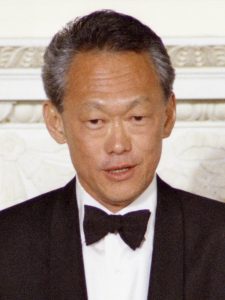
Few political leaders of the twentieth century have left as indelible an imprint on the trajectory of their nation as Lee Kuan Yew, the founding Prime Minister of the Republic of Singapore. Serving as Prime Minister from 1959 to 1990, and subsequently holding senior advisory roles in the Cabinet until 2011, Lee oversaw Singapore’s transformation from a resource-poor, malaria-ridden colonial entrepôt into one of the world’s wealthiest, safest, and most globally connected sovereign city-states. Revered by admirers as a visionary statesman and pragmatic nation-builder, and scrutinized by critics for his stringent approach to political dissent and social order, Lee Kuan Yew engineered a distinctive model of governance that continues to define Singapore today.
Early Life, Education, and Political Awakening
Born on September 16, 1923, in Singapore to a middle-class Peranakan Chinese family, Lee Kuan Yew grew up under British colonial rule. He excelled academically at Raffles Institution, Singapore’s premier English-medium school, before his education was abruptly interrupted by the Japanese invasion and occupation of Singapore from 1942 to 1945. Living under the harsh realities of wartime military rule profoundly shaped Lee’s worldview, instilling in him a lifelong conviction that a nation’s survival depends upon self-reliance, disciplined leadership, and credible defense rather than dependence on foreign protectors.
Following World War II, Lee traveled to England to study law, first at the London School of Economics and subsequently at Fitzwilliam College, Cambridge, where he graduated with a Double First in Law. During his years in Britain, he became deeply engaged in anti-colonial politics, connecting with fellow Malayan students who envisioned an independent, unified Malaya free from British rule. Upon returning to Singapore in 1950, Lee practiced law and represented trade unions and student groups, gaining grassroots political credibility that paved the way for his entry into public life.
The Road to Self-Government and Independence
In November 1954, Lee Kuan Yew co-founded the People’s Action Party (PAP) alongside a coalition of English-educated professionals and left-wing trade unionists. Navigating the turbulent political landscape of the 1950s—marked by labor strikes, communist insurgency, and communal tensions—Lee demonstrated formidable strategic acumen. When Singapore achieved full internal self-government from Britain in 1959, the PAP won a landslide victory, and at the age of thirty-five, Lee became Singapore’s first Prime Minister.
Convinced that a small island without natural resources or a domestic hinterland could not survive economically on its own, Lee campaigned vigorously for merger with the Federation of Malaya. In September 1963, Singapore joined Malaya, Sabah, and Sarawak to form Malaysia. However, deep ideological, economic, and racial disagreements soon fractured the union. While Lee advocated a “Malaysian Malaysia” built on multiracial meritocracy, the federal government in Kuala Lumpur favored policies granting special privileges to the indigenous Malay majority. Following severe communal riots in 1964 and escalating political deadlock, Singapore was separated from Malaysia on August 9, 1965.
In a televised press conference that became one of the most iconic moments in Singapore’s history, Lee visibly wept as he announced Singapore’s unexpected independence. Suddenly tasked with leading an isolated, newly sovereign microstate surrounded by larger, skeptical neighbors, Lee declared that Singapore would survive and thrive against all odds.
Pillars of Nation-Building and Economic Transformation
Under Lee Kuan Yew’s stewardship, the government embarked on an ambitious, pragmatic blueprint for economic survival and social cohesion. Recognizing that traditional entrepôt trade could not employ a rapidly growing population, Lee and his economic team—led by Dr. Goh Keng Swee—pursued an export-oriented industrialization strategy. At a time when many postcolonial nations viewed multinational corporations with suspicion, Lee actively courted foreign direct investment from the United States, Europe, and Japan, offering political stability, rule of law, efficient infrastructure, and an English-speaking, disciplined workforce.
Equally transformative were Lee’s domestic policies:
- Zero Tolerance for Corruption: Lee established a culture of strict integrity within the public sector, strengthening the Corrupt Practices Investigation Bureau (CPIB) and ensuring civil servants and ministers were paid competitive, transparent salaries to deter graft.
- Public Housing and Social Stability: Through the Housing and Development Board (HDB), the government cleared overcrowded slums and built modern, affordable high-rise apartments. By allowing citizens to purchase their flats using their Central Provident Fund (CPF) savings, Lee turned Singapore into a property-owning democracy, giving every citizen a tangible stake in the nation’s stability.
- Multiracialism and Bilingualism: Having witnessed the destructive power of communal strife, Lee enforced strict policies promoting racial and religious harmony. English was adopted as the common working language of administration and commerce to ensure economic competitiveness and neutrality among ethnic groups, while students were required to study their respective “mother tongue” languages (Mandarin, Malay, or Tamil) to preserve cultural heritage.
- Urban Greening and Infrastructure: Lee championed the vision of a “Garden City,” launching extensive tree-planting campaigns, cleaning the polluted Singapore River, and developing world-class port and aviation infrastructure, culminating in the opening of Changi Airport.
Governance Philosophy and Controversies
Lee Kuan Yew’s governance style was unabashedly elitist, meritocratic, and paternalistic. He believed that a small nation could only prosper if governed by its brightest and most capable individuals, insulated from populist pressures. While maintaining regular parliamentary elections, Lee’s administration placed strict limits on political opposition, press freedom, and public assembly, utilizing preventive detention laws against suspected subversives and defamation lawsuits against political critics and foreign publications.
To Western commentators who criticized Singapore’s curtailment of liberal democratic freedoms, Lee argued that economic development, social order, and collective well-being took precedence over Western-style individualism—a perspective often associated with the “Asian values” debate of the 1990s.
Later Years and Enduring Legacy
In November 1990, after thirty-one years in office, Lee stepped down as Prime Minister in a planned leadership transition, handing the reins to Goh Chok Tong. Lee remained in the Cabinet as Senior Minister and later as Minister Mentor under his eldest son, Lee Hsien Loong, who became Singapore’s third Prime Minister in 2004. Lee retired from the Cabinet in May 2011, remaining a Member of Parliament until his death from pneumonia on March 23, 2015, at the age of ninety-one. His passing prompted an outpouring of national grief, with hundreds of thousands of Singaporeans queuing for hours in the tropical heat to pay their final respects.
Today, Lee Kuan Yew is widely regarded by global statesmen—from Henry Kissinger to Deng Xiaoping—as one of the most consequential thinkers and practitioners of modern statecraft. By transforming a vulnerable colonial port into a global financial, technological, and logistics powerhouse within a single generation, Lee Kuan Yew proved that visionary leadership, institutional integrity, and strategic pragmatism can overcome the most daunting geographical and historical constraints.
Leave a Reply